Positionless Marketing and Modern Business Strategy
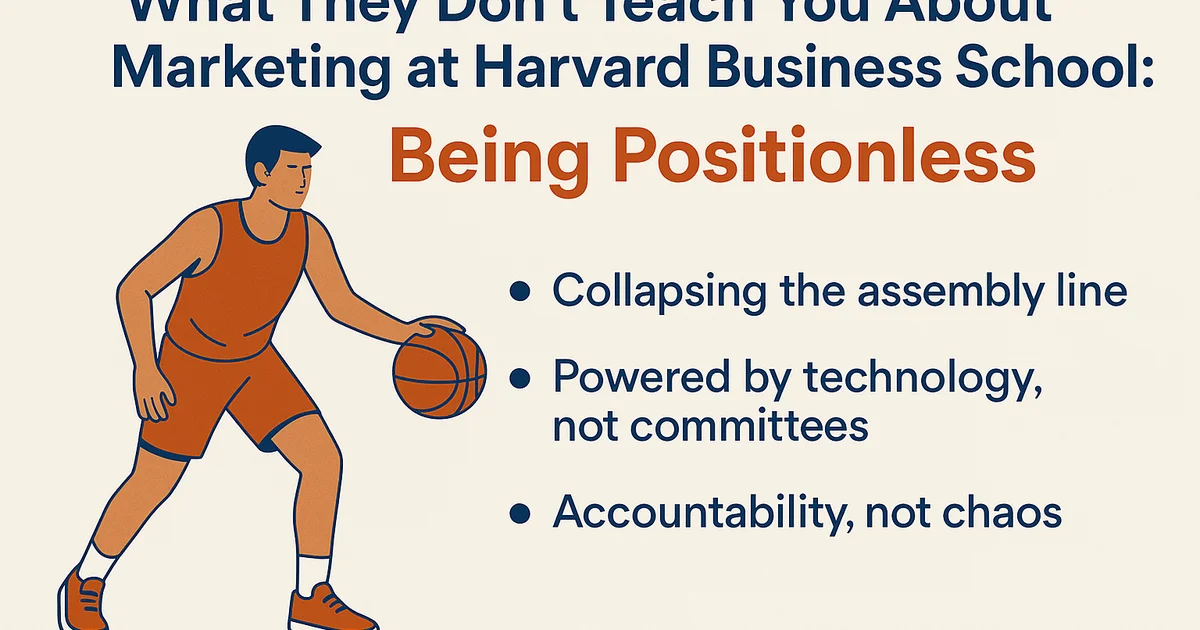
Let’s start with a confession: I love a good org chart. There’s something comforting about those neat little boxes, each with a title, a purpose, and—if you’re lucky—a clear KPI. But here’s the thing: in 2025, marketing isn’t a game of chess where every piece has a fixed move. It’s more like pickup basketball at your local gym—everyone’s a little bit of everything, and the guy who claims he’s “just a center” is probably about to get dunked on by a 5’9” point guard with a podcast.
Which brings us to the latest lesson the Ivy League forgot to put on the syllabus: being positionless.
What Does “Positionless” Even Mean?
Let’s break it down without the jargon. For decades, marketing education—especially at the big-name schools—has hammered home the gospel of positioning. Find your niche. Own your lane. Stake your claim and defend it with a moat of brand guidelines and a PowerPoint deck that could double as a doorstop.
But the world changed while we were busy color-coding our value propositions. Today, the most effective marketers aren’t the ones who cling to a single job description or wait for the analytics team to send over a report. They’re the ones who see a problem, grab the data, whip up creative, launch a campaign, and optimize—all before the rest of us have finished our second coffee.
Positionless marketing is about collapsing the assembly line. It’s about do-it-now competence, powered by technology, not committees. It’s the difference between “let’s schedule a meeting to discuss the brief” and “I saw the numbers dip this morning, so I shipped three creative variants and the save rate is already up 18%.” No tickets. No queues. No waiting for the creative team to come back from their offsite in Tahoe.
Why Should You Care? Because the Clock Is Ticking
Here’s why this matters: speed is the new unfair advantage. The brands winning today aren’t necessarily the ones with the biggest budgets or the fanciest agencies. They’re the ones who can spot an opportunity, act on it, and measure the impact before the competition has even noticed the wind has changed.
Think about it: consumer attention is a mayfly. Trends flare up and burn out in the time it takes to microwave lunch. If your marketing machine still runs on handoffs and approvals, you’re not just slow—you’re invisible.
Positionless marketing isn’t about chaos. It’s about accountability. When one person owns the insight, the creative, the launch, and the measurement, there’s nowhere to hide. Details don’t get lost in translation. The same person who saw the opportunity can prove the outcome. It’s not anti-strategy—it’s anti-handoff.
The Three Powers of the Positionless Marketer
Let’s get practical. What does it take to thrive in this new world? Three things:
- Data Power: Instant access to the numbers that matter. Not “wait a week for the BI team,” but “define and size the audience in minutes, with profit and frequency guardrails built in.” If you’re still waiting for someone to pull a list, you’re playing last season’s game.
- Creative Power: Generative tools that let you produce channel-ready copy and visuals in minutes. The old way: brief, sprint, review, miss the moment. The new way: three variants live this afternoon, with brand and compliance baked in. AI drafts the headlines, you steer the strategy.
- Optimization Power: Automated testing and real-time measurement. No more “let’s see how it did” in next month’s deck. Experiments auto-allocate to winners, journeys self-tune, and you see lift in real time.
The result? Campaigns that used to take a week go live before lunch. Teams that used to need seven people and six weeks now need one person and one day. And the kicker: you don’t need a bigger team, just a smarter workflow.
But Wait—Isn’t This Dangerous?
Let’s pump the brakes for a second. Flexibility is great, but if you’re not careful, you end up with a brand that’s all things to all people—and nothing to anyone. Being positionless doesn’t mean being flavorless. You still need a core brand essence, a North Star that guides every experiment and pivot.
The trick is to balance adaptability with consistency. Don’t chase every trend like a golden retriever after a tennis ball. Use data to guide your moves, but don’t let the algorithm turn you into a robot. Remember: data tells you the what, but brand tells you the why.
My Take: The CMO as Swiss Army Knife
Here’s where I get personal. I’ve spent enough time in boardrooms and beanbag chairs to know that the best marketers are the ones who can play every position on the court. They’re not afraid to get their hands dirty with data, but they can also spin a story that makes the numbers sing. They know when to trust the dashboard and when to trust their gut.
The positionless marketer is part analyst, part creative, part operator, and part diplomat. They’re the ones who can spot a trend on TikTok, turn it into a campaign before lunch, and have the results ready for the exec team by happy hour. They’re not waiting for permission—they’re already shipping.
And here’s the kicker: this isn’t just for startups. I’ve seen legacy brands transform by empowering their teams to own the full cycle. The result? Faster launches, tighter feedback loops, and a culture where experimentation isn’t just tolerated—it’s expected.
The Final Buzzer
So, what’s the lesson Harvard forgot to teach? In a world where the only constant is change, the most valuable marketers aren’t the ones with the fanciest title or the deepest specialization. They’re the ones who can move fast, adapt on the fly, and own the outcome from start to finish.
Marketing isn’t chess—it’s basketball. And in 2025, the MVPs are the ones who can play every position, call their own plays, and still have enough energy left to celebrate the win.
Now, if you’ll excuse me, I’ve got a dashboard to check and a campaign to launch before my next meeting. Because in this game, the clock never stops—and neither should you.